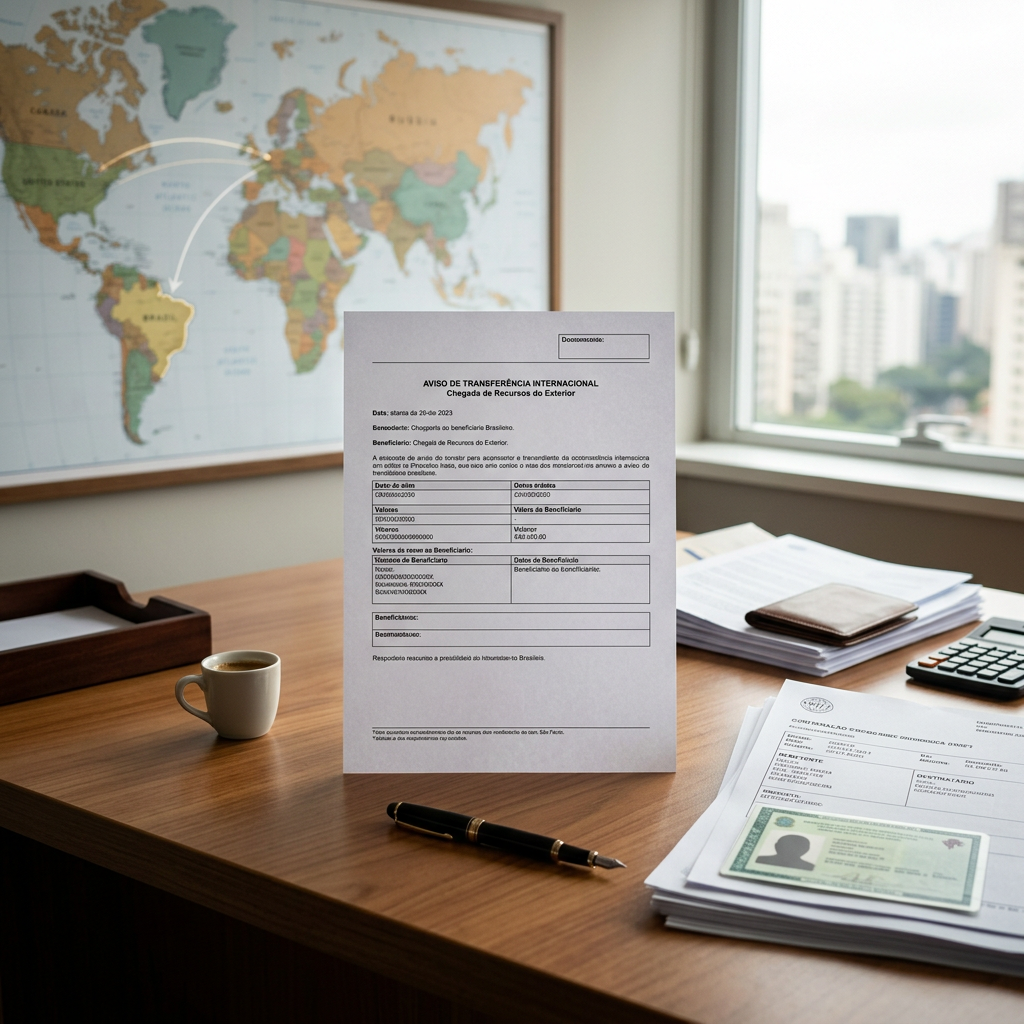
How cross-border transfers actually work, what taxes apply, and how to avoid the mistakes that create tax and immigration problems later
Every foreign investor, property buyer, or new resident eventually asks the same question: what is the right way to get money into Brazil? The honest answer is that there is no single “best” method, there is a legal method, built around Brazil’s foreign exchange control system, and there are informal shortcuts that feel convenient but create documentation gaps, tax exposure, and, in the worst cases, regulatory and criminal risk. This article focuses on the legal channel, why it exists, and how to use it efficiently.
Why Brazil regulates money coming in (and going out)
Unlike some jurisdictions with fully open capital accounts, Brazil operates a foreign exchange control regime administered by the Central Bank (Banco Central do Brasil). Every conversion between reais and a foreign currency connected to a cross-border transfer must, in principle, be channeled through an institution authorized to operate in the foreign exchange market — typically a bank, though some licensed fintechs now also hold this authorization. Each such conversion is documented through an exchange contract (contrato de câmbio), which records the parties, the amount, the currency, and critically the declared purpose of the transfer.
That declared purpose is not a formality. It determines the tax treatment (IOF rate), the reporting category the Central Bank assigns to the transaction, and, for larger amounts, the paper trail that later supports a visa application, a real estate purchase, or a tax return. Getting the purpose code wrong, or transferring funds through an ad hoc channel that skips this step entirely, is one of the most common and most avoidable mistakes foreign investors make.
The legal channel: authorized dealers and the exchange contract
The standard, fully legal path for bringing money into Brazil looks like this:
- Choose an authorized institution on both ends — a bank or licensed remittance provider abroad, and a Brazilian bank or authorized fintech that can receive the funds and execute the exchange contract.
- Declare the purpose of the transfer accurately. Common categories include property purchase, capital contribution to a Brazilian company, investment, family support, and personal savings transfer, among others defined by Central Bank regulation. Each category has its own registration code and, in some cases, its own tax treatment.
- Execute the exchange contract, converting foreign currency into reais (or, for some transaction types, allowing the funds to be held or invested without immediate conversion).
- Retain the documentation. The exchange contract, the source bank’s transfer confirmation, and — where relevant — the underlying commercial document (a property purchase agreement, a company’s capital increase minutes, an invoice) should all be kept together as a single file. This is the paper trail a lawyer will need to show, months or years later, that funds were regularly and transparently brought into the country.
For anyone planning to apply for an investment-based visa, this documentation is not optional — it is the evidence that the required capital was actually and lawfully brought into Brazil, as opposed to funds that simply appear in a Brazilian account from an untraceable source.
Foreign Direct Investment registration
When money enters Brazil as capital for a Brazilian company (foreign direct investment, or “IED” — investimento estrangeiro direto), the investment must additionally be registered with the Central Bank through its electronic registration system. This registration is what allows the foreign investor to later repatriate the capital, remit profits or dividends abroad, or sell the investment and take the proceeds out of the country without a fresh, ad hoc justification each time. Skipping this step at the time of the original investment is a common and expensive mistake — it can be fixed retroactively, but doing so is slower and more document-intensive than registering correctly from the start.
Taxation: IOF and beyond
Foreign exchange transactions in Brazil are subject to IOF (Imposto sobre Operações Financeiras — the Tax on Financial Operations), a federal tax that applies to a wide range of financial transactions including foreign exchange conversions, credit operations, and insurance. The IOF rate applicable to a given exchange transaction depends heavily on the transaction category: transfers connected to certain types of investment, for instance, have historically been taxed differently from transfers connected to personal remittances or international credit card spending abroad.
Because IOF rates are set by presidential decree rather than by statute, the federal government has adjusted them repeatedly in recent years — sometimes raising rates on categories such as international credit card use or outbound personal transfers as part of short-term fiscal policy, and at other times reducing or zeroing rates for categories the government wants to encourage, such as direct investment. The specific percentage that applies to any given transfer should always be confirmed at the time of the transaction, either directly with the receiving bank or through current Central Bank/Receita Federal publications, rather than assumed from a prior year’s rate.
Beyond IOF, two other tax questions typically arise for foreign investors moving money into Brazil:
- Income tax on the underlying funds. Bringing already-taxed savings into Brazil does not, by itself, create a new taxable event in Brazil. The analysis changes if the transfer represents Brazilian-source income (a sale, rental proceeds, dividends from a Brazilian company) that has its own withholding or reporting obligation independent of the transfer itself.
- Declaração de Capitais Brasileiros no Exterior / foreign asset reporting in the investor’s home country. Foreign investors should also confirm their home-country reporting obligations (many jurisdictions require disclosure of foreign bank accounts or foreign real estate) — this is outside Brazilian law but frequently overlooked by clients focused only on the Brazilian side of the transaction.
Why informal channels are a false shortcut
It is common for foreign nationals — particularly those transferring funds to family members, or moving smaller amounts for living expenses — to consider informal alternatives: cash carried on arrival, peer-to-peer arrangements, or unregulated remittance services operating outside the authorized dealer system. These carry real risks:
- No documentary trail. Without an exchange contract, there is no official record connecting the funds to a legitimate source. This becomes a serious problem the moment those funds are used for something that requires proof of origin — buying property, applying for a visa, or simply explaining a large deposit to a bank’s compliance department.
- Currency declaration requirements. Physically carrying more than the legal threshold in cash (currently a Central Bank/Receita Federal reporting threshold denominated in reais, adjusted periodically) into or out of Brazil without declaring it is a customs and, potentially, a criminal exposure — entirely avoidable by using the banking channel instead.
- No protection if something goes wrong. A regulated exchange contract, executed through an authorized institution, gives both parties a documented, enforceable transaction. Informal channels offer no such protection if funds are lost, delayed, or disputed.
- Anti-money-laundering exposure. Structuring transfers to avoid reporting thresholds, or routing funds through unrelated third parties to obscure their origin, can itself constitute a criminal offense under Brazilian anti-money-laundering law (Law No. 9,613/1998), independent of whether the underlying funds were legitimately earned.
For any transfer connected to an investment, a property purchase, or an immigration process, the modest additional cost and paperwork of the regulated channel is trivial compared to the risk of an undocumented alternative.
Practical strategies for common scenarios
Buying property. Funds should be transferred close to the closing date, with the exchange contract’s declared purpose matching the property transaction, and ideally in the name of the buyer as it will appear on the deed (escritura). Where a power of attorney is used, the underlying purchase agreement should be ready in advance so the purpose declaration is consistent with the paperwork the notary and property registry will later require.
Funding a Brazilian company. Capital contributions should be transferred as a registered foreign direct investment, tied to the company’s capital increase documentation (minutes of a shareholders’ or quotaholders’ meeting, amended articles of association), and registered with the Central Bank promptly — not after the fact.
Supporting an investor visa application. Because the visa process typically requires evidence that the investment capital actually entered Brazil through legitimate means, transfers should be timed and documented so that the exchange contract, the bank statement, and the underlying investment (a property deed, a company’s capital records) all tell a single, consistent, dated story.
Ongoing living expenses or family support. Smaller, recurring transfers for personal use are generally the most straightforward category, but should still go through an authorized dealer rather than informal channels, both for the recipient’s ability to explain the funds to their own bank and for the sender’s own home-country reporting obligations.
Choosing a transfer provider
The market for cross-border transfers into Brazil includes traditional international wires through banks, and a growing number of licensed fintech remittance platforms that can offer faster settlement and, in some cases, more competitive exchange spreads. Whichever provider is used, the two questions that matter are: (1) is the institution actually authorized to operate in the Brazilian foreign exchange market or partnered with one that is, and (2) will the transaction generate a proper exchange contract and transfer documentation in the receiving client’s name. A cheaper transfer that fails either test is not actually a bargain once the documentation gap surfaces later.
Working with a lawyer on transfer strategy
A Brazilian lawyer’s role in this process is less about executing the transfer itself — that is the bank’s function — and more about making sure the transfer is structured correctly before it happens: confirming the right purpose declaration, coordinating timing with the underlying transaction (a purchase, a capital contribution, a visa filing), ensuring Central Bank registration happens where required, and keeping the resulting documentation organized for whatever comes next — a tax filing, a visa renewal, or a future capital repatriation.
Frequently asked questions
Can I just wire money to a friend or relative in Brazil and have them hold it for me? This is one of the riskiest informal shortcuts. Beyond the practical problem that the funds are now legally your relative’s to explain to their own bank, using a third party to receive funds that are actually destined for your own investment or purchase can look, to a compliance officer or tax authority, like an attempt to obscure the true source or beneficiary of the money — precisely the pattern anti-money-laundering rules are designed to flag. If the funds are meant for you, they should arrive in an account in your name (or your Brazilian holding company’s name), through a properly documented exchange contract.
Do I need a Brazilian lawyer to transfer money, or can my bank handle everything? The bank executes the transfer and the exchange contract, but the bank’s compliance department is not positioned to tell you whether the purpose code you have chosen is the right one for your visa strategy, your tax situation, or your Central Bank registration obligations as a foreign investor. For any transfer connected to a property purchase, a business investment, or an immigration filing, we recommend confirming the structure with a lawyer before the transfer is executed rather than after.
How long does an international transfer to Brazil typically take? This varies by provider and by the complexity of the compliance review triggered by the transaction’s size and declared purpose. Straightforward personal transfers through established channels often settle within one to a few business days; larger transfers connected to investment or property purchases can take longer if the receiving bank requests additional source-of-funds documentation. Building in a buffer before a closing date or a filing deadline is good practice.
What happens if I already brought money into Brazil informally and now need to document it properly? This is fixable in many cases, but it is slower and more document-intensive than doing it correctly from the start — it typically involves reconstructing evidence of the funds’ origin and, where relevant, seeking to regularize the transaction with the receiving bank or, in more complex cases, with the Central Bank directly. The earlier this is addressed, the more options are available.
Final thoughts
Moving money into Brazil is straightforward once the transfer is treated as part of a documented, purpose-driven transaction rather than a simple currency exchange. The rules exist to create a clear paper trail, and that same paper trail is almost always what a foreign investor needs later — for a visa, a tax filing, or eventually taking the money back out.
This article is provided for general informational purposes and does not constitute legal, tax, or financial advice for any specific transaction. IOF rates, reporting thresholds, and Central Bank registration procedures change over time and should be confirmed against current regulations before any transfer is executed.
Planning a transfer to Brazil for a property purchase, business investment, or visa application?
Souza & Santos Advocacia structures cross-border transfers and foreign investment registration for international clients.
José Vinicios Leite Santos | OAB/PB 32.683 Souza e Santos Advocacia Av. Gov. Flávio Ribeiro Coutinho, 500, Sala 927, Manaíra, CEP 58037-005, João Pessoa — PB, Brazil contato@souzaesantosadvocacia.com.br | +55 (83) 99644-2180